
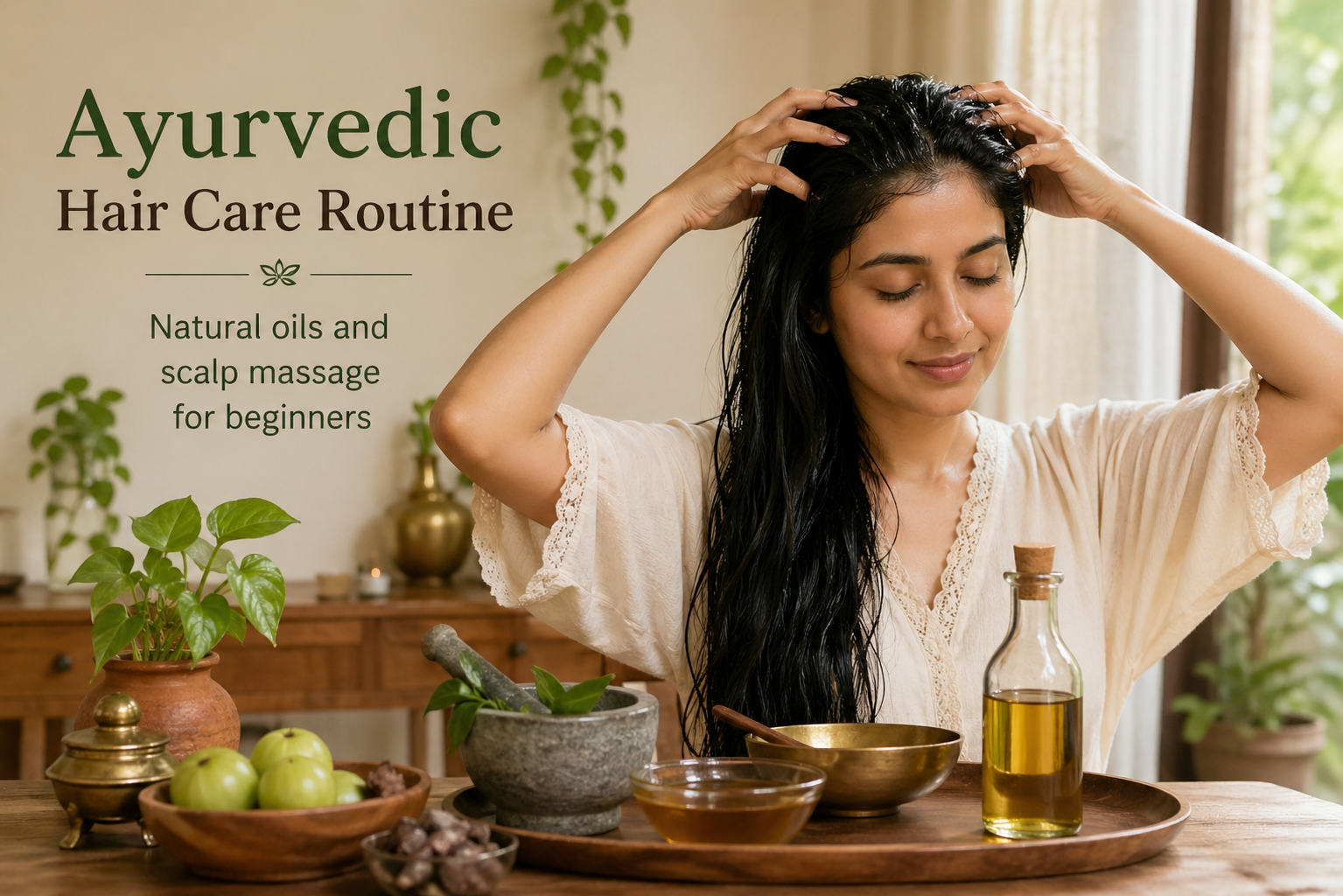
Ayurvedic Hair Rituals for Beginners: The Dinacharya Hair Routine
If you’ve heard the word Dinacharya and immediately felt intimidated, you’re not alone. It sounds complex. It isn’t. Dinacharya simply means daily routine in Sanskrit, and in Ayurveda, it refers to the set of morning and evening practices that support overall health and balance.
For hair specifically, the Ayurvedic approach is one of the most practical and effective frameworks available, and it doesn’t require hours of preparation or an entire shelf of products. An ayurvedic hair care routine built on Dinacharya principles is fundamentally about consistency, intention, and a small number of well-chosen ingredients applied regularly.
Here’s how to start.
What Is Dinacharya and Why Does It Apply to Hair?
In Ayurvedic medicine, hair health is understood as a reflection of internal balance. The three doshas, Vata, Pitta, and Kapha, each influence the hair in different ways. Vata imbalance tends to produce dry, brittle, frizzy hair. Pitta imbalance is associated with hair thinning and premature graying. Kapha imbalance can lead to oily scalp and sluggish hair growth.
Dinacharya practices address hair health indirectly through overall wellbeing, and directly through specific rituals like scalp oiling, scalp massage, and mindful cleansing. The idea is that small, consistent actions performed daily or weekly have a cumulative effect that no single intensive treatment can replicate.
This is a fundamentally different philosophy from the Western approach to hair care, which tends to focus on fixing problems as they arise. Ayurveda focuses on preventing imbalance from developing in the first place.

The Core Principles of an Ayurvedic Hair Care Routine
Before getting into the specific steps, it helps to understand the principles that underpin everything.
Oil is central. In Ayurveda, the scalp is treated as an extension of the skin and deserves the same level of nourishment. Regular oiling, known as Shiro Abhyanga, is one of the foundational practices in any ayurvedic hair care routine. The oil feeds the scalp, the massage stimulates circulation, and together they create the conditions for healthy hair growth.
Gentle cleansing matters. Ayurveda views harsh, stripping cleansers as fundamentally counterproductive. If you strip the scalp of its natural oils every wash, it compensates by overproducing sebum. The result is a cycle of greasiness and stripping that leaves the scalp perpetually off-balance.
Consistency over intensity. A weekly scalp oil and a gentle shampoo bar used consistently will outperform an intensive hair mask used once a month. This is a principle the Dinacharya framework returns to repeatedly.
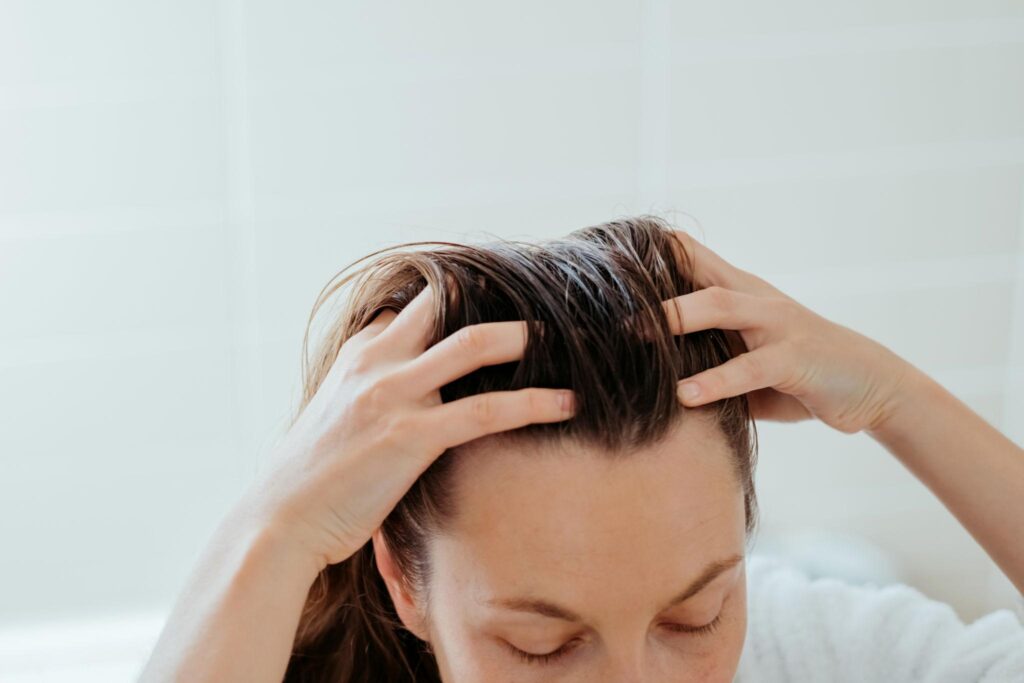
Step 1 : Weekly Scalp Oiling: Shiro Abhyanga
This is the cornerstone of any ayurvedic hair care routine, and it requires less time than most people expect.
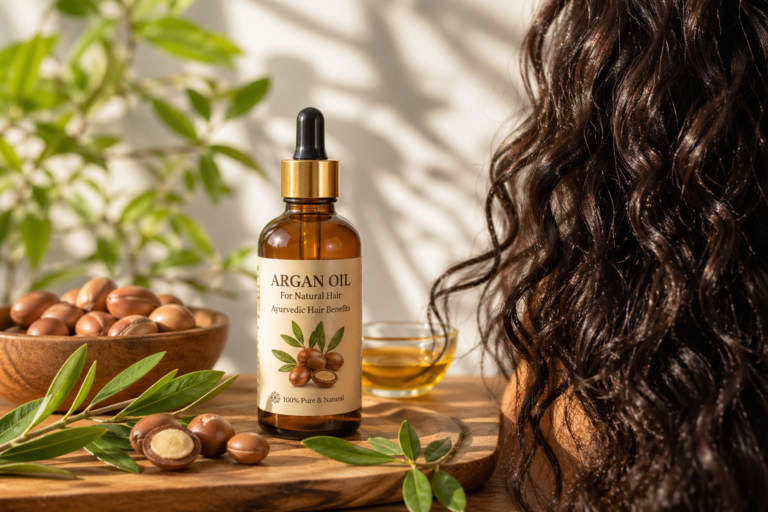
Choose a nourishing hair oil or serum suited to your scalp type. For dry or sensitive scalps, ghee-based oils are particularly well suited because of their biocompatibility and anti-inflammatory properties. For oily scalps, lighter oils like argan work better as a serum applied to the lengths rather than a heavy mask on the scalp.
Apply a small amount directly to the scalp. You don’t need to saturate the hair. A few drops distributed across the scalp and worked in with your fingertips is enough. The Shvéta Labs Hair Serum is designed exactly for this kind of daily or weekly use. A few drops on the scalp, a gentle massage of a minute or two with your fingertips, and that’s genuinely all there is to it. No heating, no preparation, no complicated process. The ghee and Damask Rose formula absorbs cleanly and works from the first application.
The massage itself is as important as the oil. Use circular movements with firm but gentle pressure across the entire scalp. Spend at least two minutes on this. A 2016 study in ePlasty found that standardized scalp massage increased hair thickness in participants over 24 weeks. The mechanism is increased blood flow to the hair follicles, which brings more nutrients to the root.
Leave the oil on for at least 30 minutes before washing, or overnight for a deeper treatment. If you leave it overnight, protect your pillow with a silk or satin pillowcase, which also reduces friction on the hair shaft while you sleep.

Step 2 : Mindful Cleansing
After oiling, you need to cleanse. The Ayurvedic approach to cleansing prioritizes removing buildup without stripping the scalp’s natural lipid barrier.
Traditional Ayurvedic cleansing used herbal powders like shikakai and reetha. In a modern context, the closest equivalent is a well-formulated shampoo bar using gentle, plant-derived cleansers rather than sulfates.
Switching from liquid shampoo to a shampoo bar is one of the most impactful changes you can make to bring your cleansing practice more in line with Ayurvedic principles. A ghee-based shampoo bar cleanses without stripping, maintains the scalp’s natural pH, and avoids the synthetic additives that conventional liquid shampoos rely on.
The cleansing ritual itself should be intentional. Wet your hair thoroughly before applying any cleanser. Work the product into the scalp with your fingertips rather than piling the hair on top of your head and scrubbing. Rinse thoroughly, longer than you think necessary.
Step 3 : Conditioning and Sealing
In Ayurveda, conditioning is not an afterthought. After cleansing, the hair cuticle is open and vulnerable. Applying a conditioning treatment at this stage smooths the cuticle, seals in moisture, and protects the hair shaft from environmental damage.
A ghee and argan oil conditioner bar addresses both the moisture and the protection dimensions simultaneously. Argan oil for hair works on the hair shaft surface, smoothing the cuticle and adding shine, while ghee nourishes more deeply. Together they create a conditioning effect that lasts between washes.
Apply conditioner to the mid-lengths and ends only, avoiding the scalp if you have oily roots. Leave it on for two to three minutes before rinsing with cool water. The cool water helps close the cuticle and lock in the conditioning benefits.
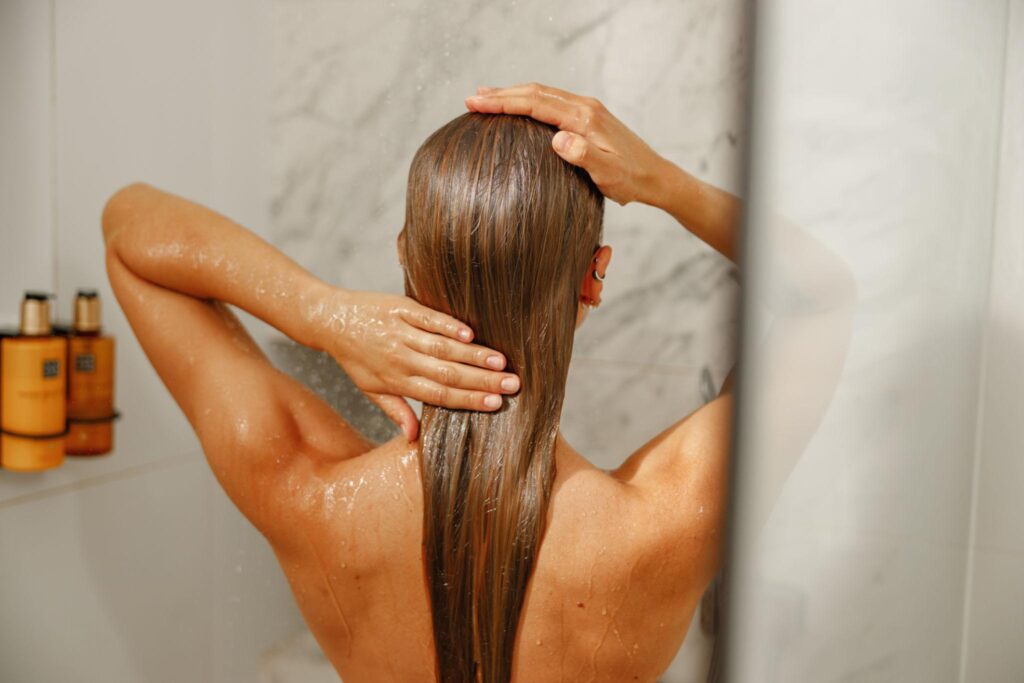
Step 4 : Drying and Protection
How you dry your hair matters more than most people realize. Aggressive towel drying creates enormous friction on the hair shaft, particularly when the cuticle is still open from cleansing. This friction leads to breakage, frizz, and split ends over time.
The Ayurvedic approach to drying is unhurried. Pat rather than rub. Use a microfibre towel or a soft cotton t-shirt rather than a conventional terry cloth towel. Allow the hair to air dry where possible, or use a diffuser on a low heat setting if you need to speed up the process.
If you use heat styling tools, applying a small amount of argan oil or a ghee hair serum to damp hair before heat provides a layer of protection. This is not a substitute for lowering the heat setting, but it meaningfully reduces cumulative damage.
Building Your Ayurvedic Hair Care Routine: A Simple Weekly Framework
For beginners, the simplest version of a Dinacharya hair routine looks like this:
Once a week, apply a few drops of hair serum to the scalp, massage for two minutes, leave for at least 30 minutes, then wash with a gentle shampoo bar and follow with a conditioning treatment.
Between washes, apply a small amount of hair serum or oil to the ends if they feel dry. Keep the scalp itself clean and avoid over-touching the hair throughout the day.
That’s it. The power of an ayurvedic hair care routine is not in its complexity but in its consistency. These simple actions, repeated weekly over months, produce cumulative results that intensive but infrequent treatments simply cannot match.
The Bottom Line
An ayurvedic hair care routine doesn’t require a transformation of your entire lifestyle. It requires a shift in philosophy: from reactive to preventative, from intensive to consistent, from stripping to nourishing.
Start with the weekly oil and massage. Add a gentle cleanser. Condition mindfully. The rest follows naturally from there.



2 Comments