Can You Use a Face Serum if You Have Acne-Prone Skin? Yes, Here’s How
Face serum acne prone skin is one of those combinations that makes people nervous. Serums often feel rich, concentrated, and potentially pore-clogging, which is the last thing acne-prone skin needs. But avoiding serums entirely means missing out on some of the most effective skincare ingredients available.
The answer isn’t to avoid serums. Finding the right face serum for acne prone skin is about understanding what ingredients work with your skin rather than against it.
Why Acne-Prone Skin Actually Needs a Serum
The instinct to keep acne-prone skin bare and minimal is understandable. But skin that’s stripped of moisture becomes reactive. When the skin barrier is compromised, it’s more susceptible to bacterial overgrowth, inflammation, and the kind of congestion that leads to breakouts in the first place.
A well-chosen serum for acne-prone skin does something counterintuitive: it calms and nourishes the skin to the point where it stops overreacting. This is the Ayurvedic principle of treating like with like. Dry, stripped, reactive skin needs nourishment, not more stripping.
The key is the formulation. Not all serums are suitable for acne-prone skin. The ingredient list, the texture, and the comedogenic rating of each component all matter. This is why choosing a face serum for acne that focuses on nourishing and calming rather than stripping makes such a fundamental difference.
What to Look for in a Face Serum for Acne-Prone Skin
Low comedogenic ingredients
Every ingredient in a serum has a comedogenic rating, a measure of how likely it is to clog pores. For acne-prone skin, avoiding ingredients with a rating of 3 or above is a sensible starting point. This rules out coconut oil, shea butter, and cocoa butter as primary ingredients in a serum, but leaves a wide range of effective options open.
Ghee sits at a comedogenic rating of 2, making it one of the safer fatty ingredients for acne-prone skin. Its anti-inflammatory butyric acid content is an additional advantage, since inflammation is a central driver of acne rather than just a consequence of it.
Calming and anti-inflammatory actives
Acne-prone skin is inflamed skin. Ingredients that actively reduce inflammation address the root of the problem rather than just its surface expression. Centella Asiatica is one of the most well-researched calming ingredients available and is suitable for almost every skin type including the most reactive. It pairs exceptionally well with ghee-based formulations because both ingredients work to reduce inflammation through different mechanisms.
Lightweight texture
A serum that sits heavily on the skin without absorbing will contribute to congestion regardless of its ingredient list. For acne-prone skin, look for serums with a fluid, fast-absorbing texture. If a serum leaves a noticeable film on the skin after five minutes, it’s likely too heavy for daily use on acne-prone skin.
No added fragrance
Synthetic fragrance is one of the most common irritants in skincare and a frequent trigger for acne-prone and sensitive skin. A serum for acne-prone skin should be fragrance-free or scented only with ingredients that have documented skin benefits, like Damask Rose.
Can Ghee-Based Serums Work for Acne-Prone Skin?
This surprises most people, but a ghee-based face serum for acne prone skin can be genuinely effective, with the right formulation and the right application method.
Raw ghee applied directly and heavily to acne-prone skin is not ideal. But ghee as a carefully formulated ingredient in a lightweight serum is a different proposition entirely.
The butyric acid in ghee has direct anti-inflammatory properties. The fatty acid profile closely mirrors the skin’s natural lipids, which means the skin absorbs it rather than treating it as a foreign substance. The fat-soluble vitamins, particularly vitamin A, support cell turnover and help prevent the pore congestion that leads to breakouts.
The comedogenic rating of 2 means it’s unlikely to cause congestion for most people. Combined with Damask Rose, which has its own soothing and antibacterial properties, a ghee and rose serum addresses several acne triggers simultaneously without irritating the skin or disrupting the barrier.
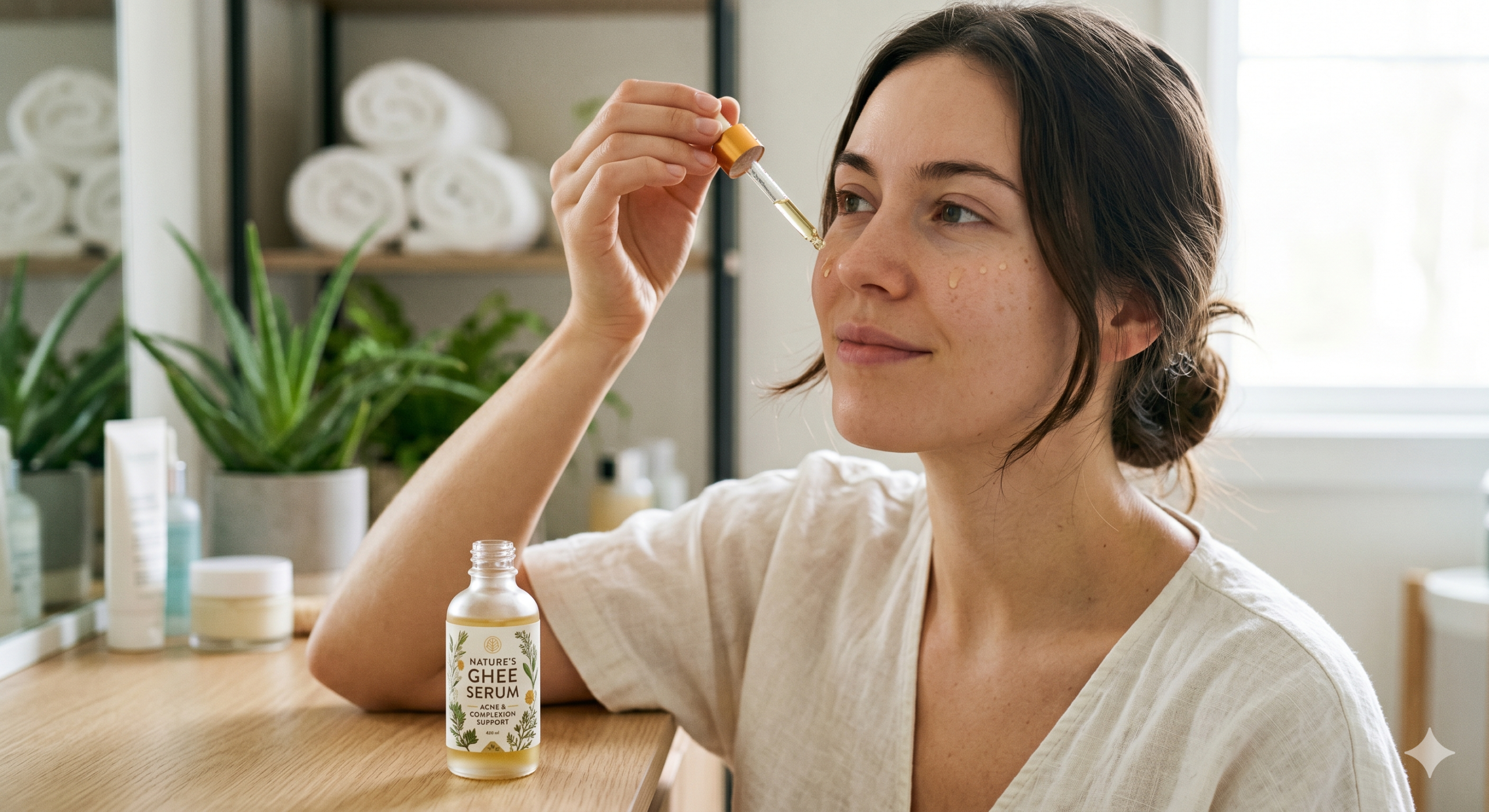
This is exactly the approach behind the Shvéta Labs Ghee and Rose Face Serum. It’s formulated to be lightweight and fast-absorbing, and the combination of ghee and Damask Rose addresses dryness, inflammation, and congestion without the heaviness that acne-prone skin can’t tolerate.
How to Introduce a Serum to Acne-Prone Skin
The introduction process matters as much as the product choice. Even a well-formulated serum can cause a temporary adjustment reaction if introduced too quickly.
Start with every other day
Apply the serum every other day for the first two weeks rather than daily. This gives your skin time to adapt without overwhelming it. If your skin responds well, move to daily use after two weeks.
Apply to clean, dry skin
For acne-prone skin, applying serum to damp skin can cause it to spread too thinly and potentially move into areas where it might cause congestion. Apply to dry skin after cleansing and wait 30 seconds before the serum application.
Use a small amount
Two to three drops is enough for the full face. Press rather than rub, working from the center outward. Give it two to three minutes to absorb before applying anything else on top.
Patch test first
Apply a small amount to the inside of your wrist or behind your ear for 24 hours before using on your face. If there’s no reaction, proceed. This step takes one day and can save weeks of skin recovery if you happen to react to an ingredient.
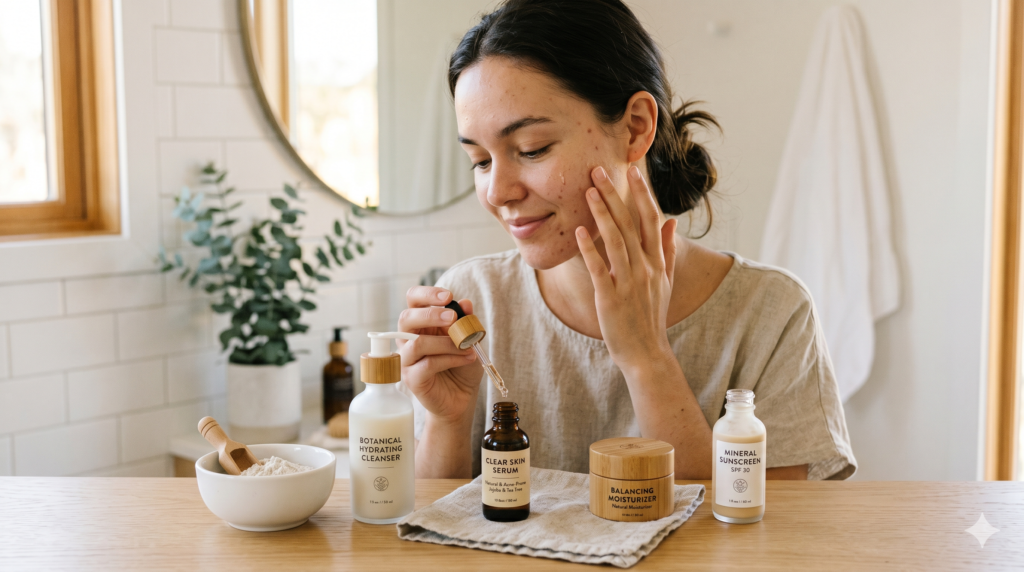
What to Pair Your Serum With
A face serum works best as part of a considered routine rather than in isolation.
For acne-prone skin, the routine around the serum matters as much as the serum itself. A gentle, sulfate-free cleanser that doesn’t strip the barrier is the essential first step. White willow bark in your cleanser adds a mild exfoliating action that keeps pores clear without the irritation of stronger acids, making it an ideal companion to a nourishing serum.
After the serum, a lightweight, non-comedogenic moisturizer seals in the nourishment without adding heaviness. In the morning, SPF is the final step. Sun exposure worsens post-inflammatory hyperpigmentation, which is the dark marks that acne leaves behind, so SPF is non-negotiable for acne-prone skin.
Signs Your Serum Is Working
Give any new serum at least four weeks before making a judgment. Skin cell turnover takes approximately 28 days, and meaningful changes in skin texture and tone take at least that long to become visible.
Signs that a serum is working for acne-prone skin include reduced redness and inflammation around existing breakouts, fewer new breakouts forming, improved overall skin texture, and a more balanced feel between wash days. Skin that was previously tight and reactive after cleansing should start to feel more comfortable.
If you experience significant new breakouts in the first week, this may be purging, where the serum accelerates cell turnover and brings existing congestion to the surface. Purging typically resolves within four to six weeks. If breakouts are large, cystic, or appearing in areas of your face where you don’t normally break out, that’s more likely a reaction to an ingredient, and you should stop using the product.
The Bottom Line
Face serum acne prone skin is not a contradiction, and the best face serum for acne is not necessarily the most aggressive one. It’s a combination that, with the right product and the right approach, can significantly improve both the frequency of breakouts and the overall health of your skin barrier.
The goal is not to strip and dry the skin into submission. It’s to nourish it to the point where it stops overreacting. That’s a more sustainable approach, and it’s the one that delivers lasting results.