
Ghee for Hair Growth: Does It Really Work? (Science-Backed)
Ghee for hair growth keeps coming up in Ayurvedic wellness circles, and for good reason. But if you’re the kind of person who needs more than anecdotal evidence before adding something new to your routine, this article is for you.
Let’s look at what the science actually says, what ghee can and can’t do for your hair, and how to use it properly.
What Is Ghee and Why Does It Matter for Hair?
Ghee is clarified butter, made by slowly cooking whole butter until the water evaporates and the milk solids are removed. What remains is pure, golden fat packed with fat-soluble vitamins and fatty acids.
For hair specifically, the nutrients in ghee are worth paying attention to. Vitamin A supports sebum production, which keeps the scalp naturally moisturized. Vitamin E is one of the most well-researched antioxidants for scalp health. Vitamin D plays a role in the hair follicle cycle. And the fatty acids, particularly Omega-3 and Omega-9, help maintain the integrity of the hair shaft from the inside out.
This isn’t marketing language. These are nutrients with documented roles in hair and scalp health.
Ghee for Hair Growth: What the Science Says
Here’s where it gets nuanced. There are no large-scale clinical trials specifically on ghee and hair growth. Anyone telling you otherwise is overselling it.
What we do have is solid research on the individual components of ghee and their relationship to hair health.
Vitamin E supplementation has been shown in a 2010 study published in Tropical Life Sciences Research to significantly increase hair count in people experiencing hair loss. Vitamin A deficiency is a well-documented cause of hair loss. Omega-3 fatty acids have been linked to reduced hair shedding in several studies.
Butyric acid, which is naturally present in ghee, has anti-inflammatory properties. Scalp inflammation is one of the lesser-discussed but significant contributors to hair thinning and slow growth. A healthier scalp environment directly supports better hair growth conditions.
So does ghee grow hair? The honest answer is: it creates the conditions in which hair can grow better. That’s not nothing. In fact, for many people dealing with dry scalp, breakage, or sluggish growth, that’s exactly what’s missing.
What Ghee Actually Does for Your Hair
Let’s be specific about the benefits you can realistically expect.
Ghee for hair growth works best as a scalp treatment and a conditioning agent. Here’s what it genuinely does well:
It seals moisture into the hair cuticle, which reduces breakage. Less breakage means your hair retains more length over time, which looks like growth even when the growth rate itself hasn’t changed.
It soothes dry, inflamed scalps. A well-nourished scalp is a better environment for hair follicles.
It improves elasticity. Hair with good elasticity stretches without snapping, which means less damage during detangling and styling.
It adds shine without silicones. The fatty acids coat the hair shaft and reflect light naturally.

How Ayurveda Has Used Ghee for Hair for Thousands of Years
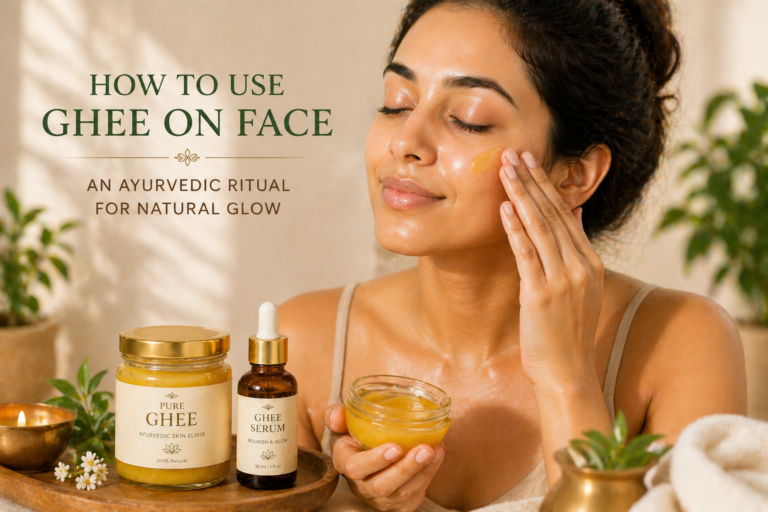
In Ayurvedic medicine, the scalp is treated as an extension of the skin, deserving the same level of nourishment and care. Ghee has been used in head massage rituals, known as Shiro Abhyanga, for millennia.
The practice involves warming the ghee slightly and massaging it into the scalp with firm, circular movements. The massage itself stimulates blood circulation to the hair follicles. The ghee delivers nutrients directly to the scalp. Together, they create a ritual that addresses both the physical and the sensory dimensions of hair care.
This isn’t folk medicine being romanticized. Scalp massage has been studied in modern contexts too. A 2016 study in ePlasty found that standardized scalp massage increased hair thickness in participants over 24 weeks.
Ghee vs. Other Hair Oils: How Does It Compare?
Coconut oil is probably the most popular natural hair oil, and it deserves its reputation. It has a small molecular structure that allows it to penetrate the hair shaft rather than just coating it. But it has a comedogenic rating of 4 out of 5, which can be problematic for oily or acne-prone scalps.
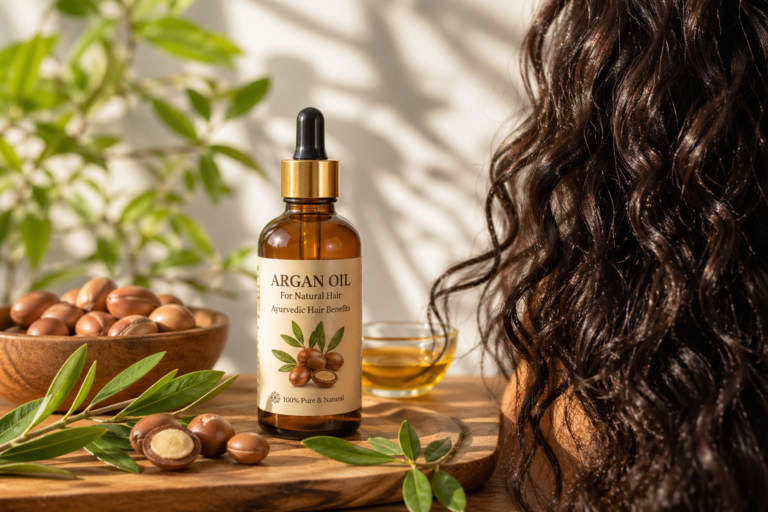
Argan oil is excellent for surface shine and detangling but works primarily on the hair shaft rather than the scalp.
Ghee sits in an interesting middle ground. Its comedogenic rating is lower than coconut oil at around 2, making it more suitable for sensitive scalps. Its fatty acid profile is broader than argan oil, and its nutrient content, particularly the fat-soluble vitamins, is genuinely impressive.
The most effective approach is often a combination. Ghee and argan oil together, for example, address both scalp nourishment and hair shaft conditioning in a way that neither does alone.
How to Use Ghee for Hair Growth
There are 2 main approaches: direct application and formulated products.
Direct application means using pure ghee as a scalp mask. Warm a small amount, massage it into your scalp for five to 10 minutes, leave it on for 30 minutes to an hour, then wash out with a gentle shampoo. Do this once a week. The downside is that pure ghee can be heavy and difficult to rinse out completely, especially with fine hair.
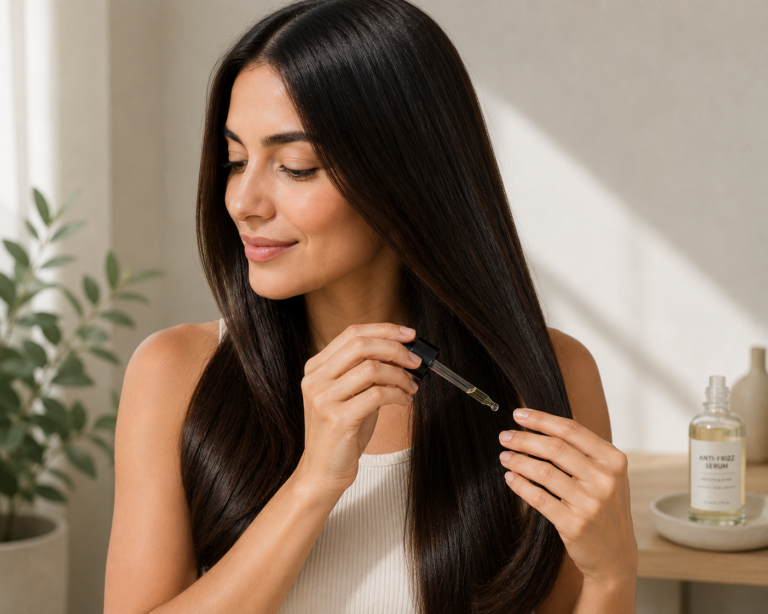
Formulated products, where ghee is combined with complementary ingredients, are often more practical for daily use. A well-made ghee hair serum, for example, delivers the benefits of the ingredient in a lightweight, non-greasy form that works on damp or dry hair without weighing it down.
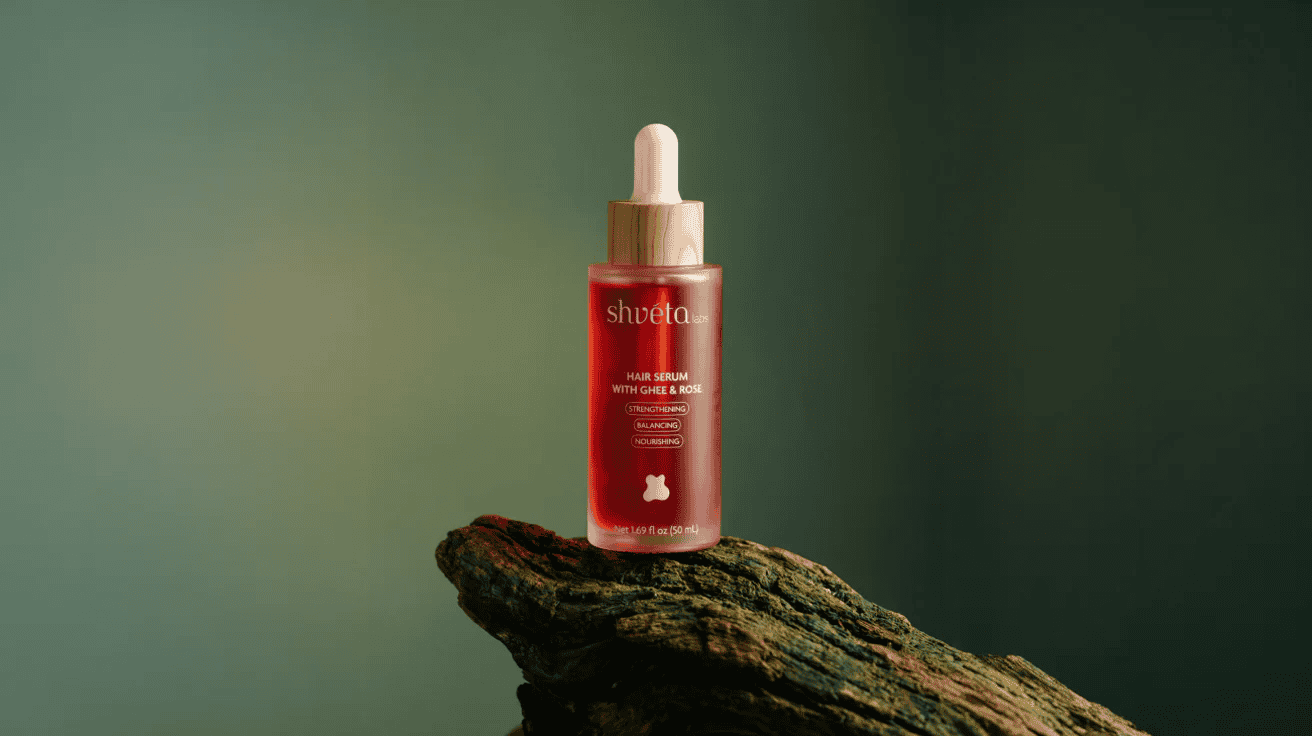
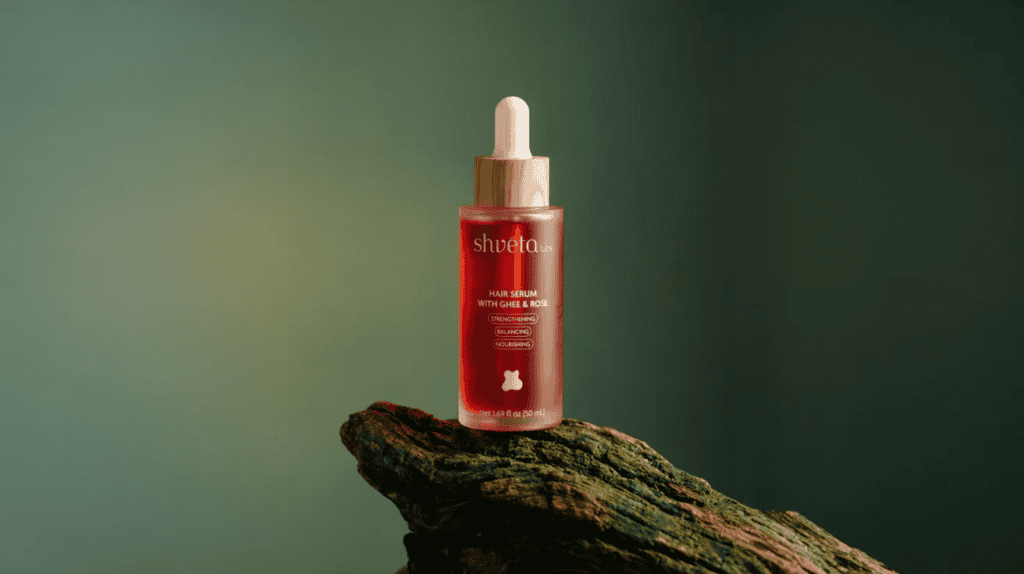
One product worth mentioning here is the Shvéta Labs Ghee and Rose Hair Serum. It combines ghee with Damask Rose and Pumpkin Seed Extract, which supports stronger roots over time. It’s lightweight enough for daily use and absorbs quickly, which makes it genuinely easy to incorporate into a regular routine.
Who Should Try Ghee for Hair?
Ghee for hair growth is particularly well suited for certain hair types. If you have dry or damaged hair, a dry or sensitive scalp, hair that breaks easily or lacks elasticity, or if you’re simply looking to simplify your routine with fewer and better ingredients, ghee for hair growth is worth trying consistently.
It’s less ideal for very fine hair that gets weighed down easily, though formulated serums rather than raw ghee tend to work better in this case.
The Honest Bottom Line
Ghee for hair growth won’t give you 2 inches of new hair in a month. Nothing will. But it will give your scalp the nourishment it needs to create better conditions for growth, and it will significantly improve the health and appearance of the hair you already have.
In Ayurveda, the goal was never quick fixes. It was building a foundation, slowly and consistently, that supports the body’s natural capacity to thrive.
That philosophy applies just as well to your hair routine.



2 Comments