What Is ECOCERT Certification? Why It Matters for Your Skincare
If you’ve ever picked up a skincare product, noticed the word “natural” on the label, and wondered whether it actually meant anything, you’re asking the right question. The truth is, without an organic skincare certification from an independent body, the word “natural” means absolutely nothing. Any brand can use it.
ECOCERT is one of the most recognized forms of organic skincare certification available today. Here’s what it is, what it actually verifies, and why it should change how you shop for skincare.
The Problem With “Natural” Skincare
The skincare industry is largely self-regulated when it comes to ingredient claims. In the United States, the FDA does not define “natural” for cosmetic products, which means brands can use the term freely without meeting any specific standard. In India, similar gaps exist. A product can contain one natural ingredient among twenty synthetic ones and still legally call itself natural.
This is not a minor technicality. It affects what goes onto your skin daily, what gets absorbed into your bloodstream, and what gets washed into the water supply every time you rinse. For consumers who are trying to make informed choices, the label “natural” without certification is essentially meaningless.
Organic skincare certification from an independent body like ECOCERT exists precisely to fill this gap. It moves the verification out of the brand’s hands and into those of an external auditor with nothing to gain from approving substandard products.
What Is ECOCERT?
ECOCERT was founded in France in 1991, originally to certify organic agricultural products. It expanded into cosmetics in 2002, becoming the first certification body in the world to develop a specific standard for natural and organic cosmetics. Today it operates in more than 130 countries and is considered one of the most rigorous and widely respected organic skincare certification bodies globally.
The certification process is not a one-time approval. ECOCERT conducts annual on-site inspections of every certified brand, supplemented by unannounced audits throughout the year. Samples are taken for laboratory analysis. The entire supply chain is audited, from the sourcing of raw materials through to the finished product and its packaging.
This level of scrutiny is what separates ECOCERT from self-declared “natural” or “organic” claims on product labels, and what makes it one of the most trusted forms of organic skincare certification in the world. You can verify the full certification requirements directly on the ECOCERT official website.
What ECOCERT Actually Checks
This is where the certification becomes meaningful in practical terms.
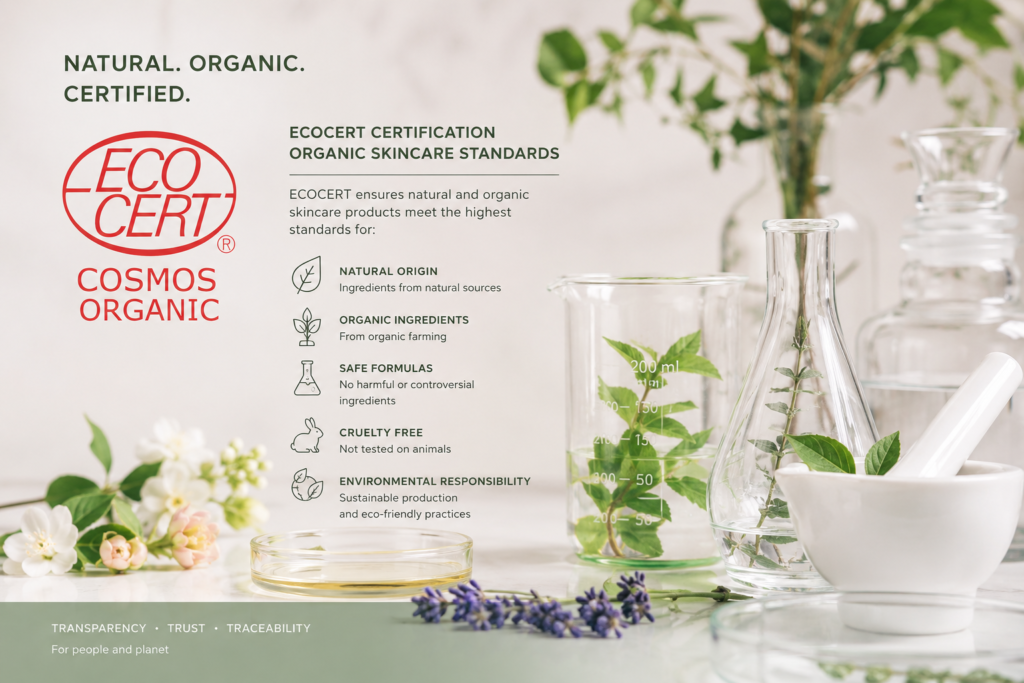
To receive ECOCERT certification, a product must meet strict criteria across several categories. At least 95% of all ingredients must come from natural origin. Petrochemical ingredients are prohibited, with only a very small list of approved preservatives as exceptions. The product must be free from parabens, phenoxyethanol, nanoparticles, silicones, PEGs, synthetic fragrances, and synthetic colorants.
The sourcing of ingredients matters too. Raw materials must come from renewable, environmentally responsible sources. Processing methods must respect strict green chemistry principles. Packaging must be biodegradable or recyclable.
For a brand to use the ECOCERT logo, every single one of these criteria must be met and verified by an independent auditor. There is no shortcut and no self-certification.
ECOCERT vs COSMOS: Understanding the Relationship
You may have seen both ECOCERT and COSMOS on product labels and wondered what the difference is. They’re related but not identical.
COSMOS is an international standard developed by five of Europe’s leading natural cosmetic certifiers, one of which is ECOCERT. It was created to harmonize different national certifications into one globally recognized standard. ECOCERT now certifies products under the COSMOS standard in addition to its own private standard.
In practical terms for the consumer, both logos on a product indicate that it has passed rigorous third-party verification. COSMOS certification is becoming the more internationally recognized standard, particularly for brands operating across multiple markets including the US, India, and Europe simultaneously.
When you see either ECOCERT or COSMOS on a product, you can be confident the “natural” or “organic” claim on the label has been verified by someone with no commercial interest in the outcome.
Why Organic Skincare Certification Matters More Than You Think
The average person uses between seven and twelve personal care products daily. Each of those products contains multiple ingredients that are absorbed through the skin, inhaled, or washed into the water system. The cumulative effect of synthetic chemicals from uncertified “natural” products adds up over years of daily use in ways that individual product safety testing doesn’t capture.
Organic skincare certification addresses this at the formulation level. By requiring that at least 95% of ingredients come from natural origin and prohibiting the most commonly problematic synthetic chemicals, ECOCERT significantly reduces your daily chemical load across all the products you use.
For people with sensitive skin, this matters even more. Many of the synthetic ingredients that ECOCERT prohibits, including certain preservatives, synthetic fragrances, and PEGs, are among the most common triggers for skin sensitivity and irritation. A certified product removes much of the guesswork around why your skin is reacting.
What Organic Skincare Certification Does Not Guarantee
It’s worth being honest about the limitations.
ECOCERT certification verifies ingredient origin, sourcing practices, manufacturing processes, and packaging. It does not make specific claims about a product’s efficacy for any particular skin concern. A certified product is not automatically more effective than a non-certified one for a specific issue like acne or hyperpigmentation.
Certification also does not mean a product is suitable for every skin type. Natural ingredients can still cause reactions in people with specific sensitivities or allergies. Patch testing remains important regardless of certification status.
What certification does guarantee is that the ingredient claims on the label have been independently verified, that the formula meets strict standards for natural origin and prohibited substances, and that the brand is subject to ongoing external scrutiny rather than self-regulation.
How to Read Certification Labels on Skincare Products
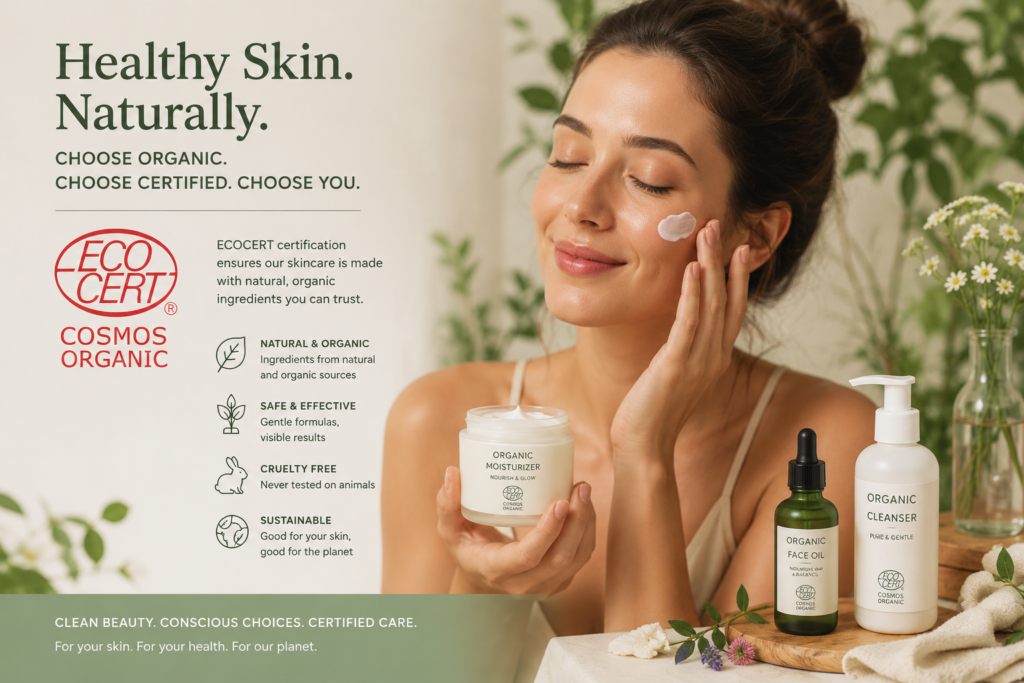
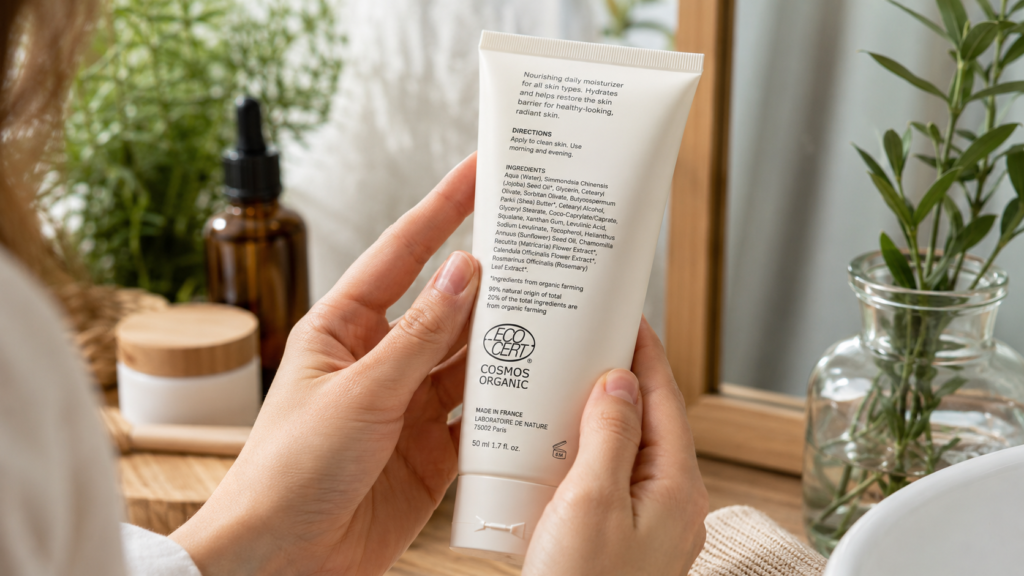
When evaluating a product for organic skincare certification, look for the certification body’s name or logo on the packaging along with the specific standard it was certified under. ECOCERT certified products will display the ECOCERT logo, often alongside COSMOS NATURAL or COSMOS ORGANIC depending on the level of organic content in the formula.
COSMOS NATURAL requires at least 95% natural origin ingredients. COSMOS ORGANIC has the additional requirement that a minimum percentage of ingredients come specifically from organic agriculture. The organic designation is the more stringent of the two.
Be aware that some brands display language like “formulated with ECOCERT ingredients” without holding full product certification. This means some individual ingredients were sourced from ECOCERT-certified suppliers, but the finished product itself has not been independently audited. It’s a meaningful distinction.
If you’re building a cleaner skincare routine from scratch, these 2 guides are a good place to start: how to choose the right face serum for acne-prone skin and what white willow bark actually does as a natural alternative to salicylic acid.
The Bottom Line
Organic skincare certification from a body like ECOCERT is the most reliable way to know that a product’s natural or organic claims have been independently verified. In a market where “natural” can mean almost anything, that verification matters.
It doesn’t replace understanding ingredients or patch testing for your own skin. But it does remove a significant layer of uncertainty from your purchasing decisions, and for daily-use products applied to your skin year after year, that matters more than most people realize.
When a brand has done the work to earn and maintain organic skincare certification through a body like ECOCERT, it’s telling you something meaningful about how seriously they take their formulations. That’s worth paying attention to.